Sunday, 3 November 2019

Maureen Lander Flat-Pack Whakapapa Exhibition

The Christchurch Art Gallery had a wonderful exhibition by Maureen Lander called Flat-pack Whakapapa, being toured by The Dowse Art Museum.

Creates Sew Slow: Maureen Lander Flat-Pack Whakapapa Exhibition

The original exhibition held in 2017 at The Dowse Art Museum can be viewed here. There are two more confirmed venues for this touring exhibition: (1) Whakatāne Library and Exhibition Centre 2 December 2019 to 3 February 2020; and (2) Waikato Museum, Hamilton 27 June to 4 October 2020.

A very thought provoking exhibition, giving imagery to the different concepts of whanau today not just our genetic family and ancestors but how friends are part of the concept of family as we can be so geographically disperse from our genetic family.  The kit-set whanaungatanga piece was a very graphic example of how our "family" can alter, we can play different roles within it and some of the "family" move away and others join and is perhaps a more fluid grouping today than it would have been for our ancestors. Of course I also really enjoyed the visual stimulation of the woven pieces themselves, the different patterns and colours of this traditional Māori art.

Exhibition statement
Heritage and knowledge passed down from ancestors

Just as whakapapa reflects a person's lineage and biology, the first line of a kete determines how its patterning and size will develop. Here, Maureen Lander has created three installations that explore the connections between whakapapa and raranga.

Flat-pack Whakapapa is about kinship, family and friendship networks as well as genetic heritage. Approaching human connection from a mātauranga Māori perspective, Lander engages with weaving techniques - including whiri and whakairo - and the concepts of aho tuku iho.

Building on the notion that our whakapapa is always with us, Lander's installations can be packed down into individual weavings that are easily carried around, reconfigured and added to later. Her approach symbolises the way our whakapapa grows with us, and how our genealogy is inherited by our descendants, who continue our heritage lines. By representing whakapapa as a series of portable weavings, Lander explores the idea that even though whānau migrate away from their tūrangawaewae, hapū, and iwi they always carry their culture with them.

Using an everyday idea like the flat-pack design to symbolise deeply held cultural beliefs such as whakapapa, Lander contributes to a wider, ongoing conversation amongst contemporary Māori artists who address customary knowledge in ways that are relevant for new generations.

He taonga tuku iho nō ngā tūpuna

Pēnā i tā te whakapapa whakaatu i ō te tangata kawai, ma te whiri o te kete e whakatau i tona hanganga. Nā, kua waihanga a Maureen Lander i ngā toi e toru nei, e whakatewhatewha ana i ngā hononga o te whakapapa me te raranga.

Ko te kaupapa matua o tēnei whakaaturanga, ko te hononga: whānau mai, hoa mai, ira mai. Nā te tino māori nei o te aronga a Lander ki tēnei kaupapa, ka riro mā te āhua-a-mahi o te raranga - pērā i te whiri me te whakairo - me te aho tuku iho hoki te hononga tangata e hiwa ai.

Heoi, mā runga tonu i te whakaaro 'he mea kawe te whakapapa e te tangata, ao te pō, pō te ao' e āhei ana te wetewete me te pōkai i ngā mahi toi a Lander hei wāhanga raranga motuhake. He ngāwari noa te kawekawe haere, te whakaemi mai anō, me te tāpiripi i atu i ngā mea hou. Mā wēnei mahi toi, e taea ai te kitea, ka tipu ngātahi te whakapapa me te tangata, ā, ka tuku iho te ira ote tangata ki ōna uri, mā rātou anō te pā harakeke e whakatipu, e whakanui. Otirā, mā te whakataurite i te whakapapa hei raranga kawekawe, e whakaatu ana a Lander i tenei whakaaro nei: ahakoa wehe te whānau i tōna tūrangawaewae, hapū, iwi rānei, ka kawea tonutia e a ia tōna ake ahurea.

Mā te whakamahi i te āhuatanga 'kai-paipa' nei o te taputapu pōkai hei tūāpapa mō te whakapapa, e whakawhānui ana a Lander i te puna wānanga o ngā kaimahi Māori toi moroki o nāianei, rātou e aro ana ki te tukunga o te mātauranga Māori kia mārama ake ai ngā reanga kei te tipu mai.

Flat-pack Whakapapa 2017 (harakeke, muka) Collection of the artist

Whakapapa - genealogy; to make layers; to lie flat

Creates Sew Slow: Maureen Lander Flat-Pack Whakapapa

Artists Statement: This continuous line of kete, stacked in layers on a plinth and extending up on the wall, has been made to represent whakapapa through the weaving techniques of raranga and whiri. Stacked like archaeological layers, every line embodies a generation and an ancestor, with the older generations at the bottom and the younger generations at the top.

This configuration allows the installation to be experienced with an aho tuku iho reading for the first four ancestors, and a tupu reading for the following generations. The formation pays tribute to the Māori belief that while your ancestors came before you, they are not gone or in the past, but guiding you into the future.

While this installation is left open for anyone to consider their genealogy, Lander created it with her own whakapapa in mind. Most significantly, she has chosen to represent a line through her Ngāti Awa ancestor, Puhi Moana Ariki, to acknowledge and illustrate a whakapapa connection to the 'Awa' line that is present in the Hutt Valley and Wellington through Te Atiawa.

diy DNA 2017 (harakeke, muka) Collection of The Dowse Art Museum purchased 2017

DNA - deoxyribonucleic acid, consisting of two long chains of nucleotides twisted into a double helix: the carrier of genetic information.

Creates Sew Slow: Maureen Lander diy DNA

Creates Sew Slow: Maureen Lander diy DNA

Artists Statement: Through her engagement with whakapapa, Lander has come across the contemporary phenomenon of genealogy testing websites such as AncestryDNA. Here, for a small cost, participants can find out their genetic make-up by posting a small sample of saliva for testing.

For this installation, Lander has used rolled leaf-strips and whiri to mimic the ladder-like structure of DNA. This structure also references the Māori story of Te Ara Pikipiki a Tāwhaki, which tells how the legendary figure Tāwhaki climbed up vines from earth to the spiritual realm. In Christian and Judaic tradition, 'Jacob's ladder' references the Old Testament story in which Jacob dreams of a stairway that symbolises the connection between heaven and earth.

diy-DNA opens a space to consider why similar narratives unfold within different cultures and religions, and how mythology, science and technology have all been used throughout human history to try to understand where we come from, and what makes us who we are.

Kit-set Whanaungatanga 2017 (harakeke, Teri dyes) Collection of the artist

Whanaungatanga - family connections, kinship patterns, reciprocal relationships.

Creates Sew Slow: Maureen Lander Kit-set Whanaungatanga

Creates Sew Slow: Maureen Lander Kit-set Whanaungatanga
Individual photographs of a few of my favourites
Artists Statement: The concept of whānau originates from family and the extended kinship lines of whakapapa patterns. Today many of us live apart from family and often create social groups centred on belonging through shared experiences and work. It is also common to refer to these groups as whānau.

Kit-set Whanaungatanga epitomises this viewpoint in the way it has been created and exhibited. In previous exhibitions, Lander invited a group of weavers to contribute kete to this installation, and each was then asked to make several pieces with a predetermined set of criteria that included technique, size, colour and pattern. However, within each kete setup, every weaver had some freedom to choose their own variations and express their skills, creativity and individuality.

When displayed on the gallery wall, Kit-set Whanaungatanga can be reconfigured in a variety of ways. The individual pieces are symbolic of the different personalities who make up any given group - each distinctive but related - creating a visual statement about the nature of whanaungatanga.

Created from a concept by Maureen Lander assisted by her 'A' team ('A' stands for āwhina, which means to help, befriend): Mandy Sunlight, Mākareta Jahnke, Janie Randerson, Jan Barratt, Tira (weavers group), supported by Suzie Campbell (meals) and Heather Randerson (photo documentation).

The packing crate

Artists Statement: For this iteration of Flat-pack Whakapapa, artist Maureen Lander has emphasised the mobility of the work by leaving the bespoke crate it is shipped in on display. Lander says "the crate itself can be a metaphor for whakapapa - whaka (to make), papa (flat or in layers)". The crate was made by Georgia Morgan, registrar at The Dowse Art Museum, who are touring Lander's exhibition.

Creates Sew Slow: Maureen Lander Flat-Pack Whakapapa Exhibition

Glossary

aho tuku iho - ancestral lines handed down continuously from generation to generation, lines coming downwards
hapū - extended family
iwi - tribe
kete - basket, kit
mātauranga Māori - Māori knowledge
raranga - Māori weaving, plaitwork
Te Ara Pikipiki a Tāwhaki - The Pathway Climbed by Tāwhaki
tupu - upwards
tūrangawaewae - the place you belong to through your whakapapa
whakairo - patterning
Whakapapa - genealogy
whānau - family
whiri - braiding

Tuesday, 29 October 2019

A Mini Travel Wardrobe for Akaroa in the Spring

I have been a bad blogger recently finding myself indulging in more dream sewing and blogging than the real thing. Just to top it off Blogger is being a very selective friend. Does it have feelings? Have I offended it with my inattention? Why does it not publish my post (when I finally write one)? Or tell me when I have comments? These are the big burning questions of the universe - oh alright stupid first world technology glitches which if I don't stress will miraculously cure themselves so onto the real point of this little missive.

Normally my beloved is responsible for travel arrangements when we are together but as it was a surprise for him the organising of this trip was all mine. And I managed to do a good job even if I do say so myself. There was a little hiccup to begin with due to a small double booking glitch which was sorted by a change in location and bach. A bach (pronounced 'batch') is a small, often very modest holiday home or beach house in New Zealand.

As this was a short trip away I didn't want to spend most of that time travelling so we drove over the hill to Akaroa. Akaroa is Kāi Tahu Māori for 'long harbour' which would be spelled 'whangaroa' in standard te reo (Māori).

The travel wardrobe

Despite only being away for two nights I took two pairs of trousers just in case. Nothing worse than slopping your dinner over yourself and having no spare clothes to change into. In reality this many garments would have been fine for a longer trip away. At least between us we only needed my Hedgren duffle bag. We took way more food (and alcohol) than clothes.

Creates Sew Slow: A Mini Travel Wardrobe for Akaroa in the Spring
Top: Untouched World Zip Through Parker; World SS16 Napoleon jacket; Camper Twins Luis Gordillo Sneakers
Middle: Untouched World Zephyr Ecopossum Coat Cardi; Untouched World Pure Skinny Indigo jeans; Papercut Peter and the Wolf Coloured Mote jeans
Bottom: World SS17 Slang T; Silhouette Marie's Nicholas James Sweater; Style Arc Rosie Alice top

The holiday bach

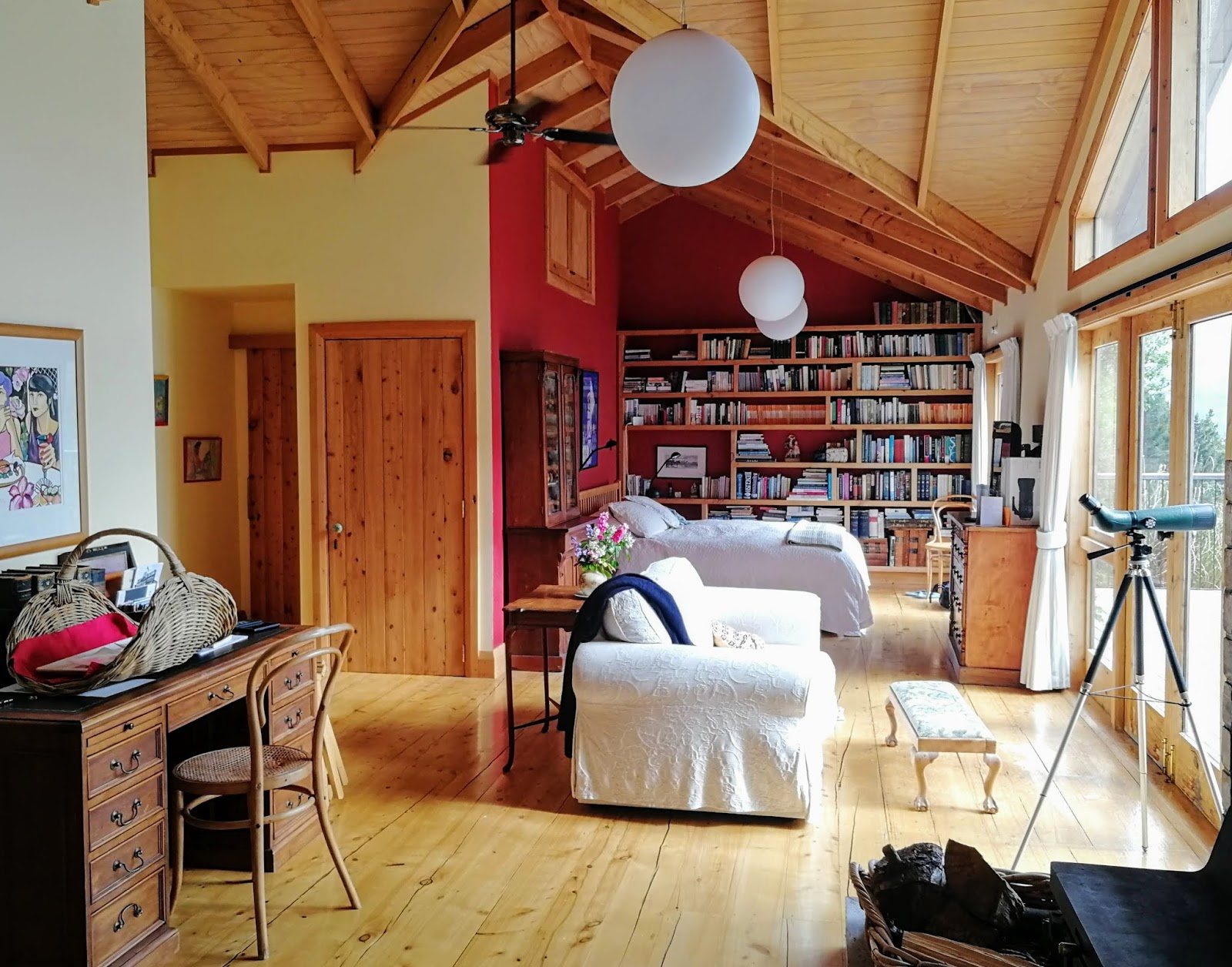
I managed to find a really wonderful place to stay, a little way out from the centre of Akaroa, set in extensive grounds with access to the sea, and what appeared to be a great garden for meandering. Due to the inclement weather we didn't take advantage of the outside spaces but we did greatly enjoy the log burner and the plentiful supply of logs.

We had a large open plan space with a fully equipped kitchen at one end and the bed at the other. Just the weekend for that wall of books!

Creates Sew Slow: A Mini Travel Wardrobe for Akaroa in the Spring

Creates Sew Slow: A Mini Travel Wardrobe for Akaroa in the Spring

Creates Sew Slow: A Mini Travel Wardrobe for Akaroa in the Spring

The view from the deck was stunning, across Akaroa harbour to Tikao Bay and Wainui. In the evening we could watch the car and house lights shimmering across the water.

Creates Sew Slow: A Mini Travel Wardrobe for Akaroa in the Spring

Creates Sew Slow: A Mini Travel Wardrobe for Akaroa in the Spring

The garden
Creates Sew Slow: A Mini Travel Wardrobe for Akaroa in the Spring

Out and about on Banks Peninsula

First stop after a leisurely morning doing nothing and a lunch of leftovers from Friday night's antipasto tea we drove into Akaroa for a small taste of the Frenchfest. Crowds were minimal probably because of the wet weather and our late start.

Creates Sew Slow: A Mini Travel Wardrobe for Akaroa in the Spring

Creates Sew Slow: A Mini Travel Wardrobe for Akaroa in the Spring

Creates Sew Slow: A Mini Travel Wardrobe for Akaroa in the Spring

Creates Sew Slow: A Mini Travel Wardrobe for Akaroa in the Spring

And at the other end of town...

Creates Sew Slow: A Mini Travel Wardrobe for Akaroa in the Spring

Creates Sew Slow: A Mini Travel Wardrobe for Akaroa in the Spring

Yay the sun came out. Briefly.

Creates Sew Slow: A Mini Travel Wardrobe for Akaroa in the Spring

Up the hill to Ōnuku Marae, close by the waters edge.

Creates Sew Slow: A Mini Travel Wardrobe for Akaroa in the Spring

Creates Sew Slow: A Mini Travel Wardrobe for Akaroa in the Spring

On the way back down Onuku Road I took this panorama of Akaroa harbour and an OOTD picture with the sheep.

Creates Sew Slow: A Mini Travel Wardrobe for Akaroa in the Spring

Creates Sew Slow: A Mini Travel Wardrobe for Akaroa in the Spring

On Sunday we drove home with a slight detour to Tikao Bay and Wainui to see Akaroa from across the water.

Duvauchelle Bay with its colourful boatsheds

Creates Sew Slow: A Mini Travel Wardrobe for Akaroa in the Spring

Creates Sew Slow: A Mini Travel Wardrobe for Akaroa in the Spring

Petit Carenage Bay

Creates Sew Slow: A Mini Travel Wardrobe for Akaroa in the Spring

Tikao Bay, complete with boating club and wooden fisherman, looking across the harbour to Akaroa

Creates Sew Slow: A Mini Travel Wardrobe for Akaroa in the Spring

Creates Sew Slow: A Mini Travel Wardrobe for Akaroa in the Spring

Creates Sew Slow: A Mini Travel Wardrobe for Akaroa in the Spring

On the windy road ever upwards out of Wainui looking back down Akaroa harbour and up toward the harbour entrance. The OOTD picture is missing the sheep as they all ran away.

Creates Sew Slow: A Mini Travel Wardrobe for Akaroa in the Spring

Creates Sew Slow: A Mini Travel Wardrobe for Akaroa in the Spring

Creates Sew Slow: A Mini Travel Wardrobe for Akaroa in the Spring

And finally...

The Silhouette Patterns Marie's Nicholas James Sweater has never been blogged even though it accompanied me to Houston in 2018 and is a firm wardrobe favourite.

Creates Sew Slow: Silhouette Patterns Marie's Nicholas James Sweater
Marie's Nicholas James Sweater posing in the foyer at the Doubletree Downtown Houston
It was made using a wonderful Liberty of London Dufour jersey purchased from Miss Maude. I really wish Liberty would produce jersey knits again, it is a great substrate for their wonderful prints, 100% cotton and so comfortable to wear.

Creates Sew Slow: Silhouette Patterns Marie's Nicholas James Sweater
Liberty of London Dufour jersey, design Nicolas James in colourway coral
For this top I wanted more of a swing shape at the bottom so I combined Silhouette Patterns #195 Sweater Set with #310 Marie's Top. The French dart in this top is a bit odd as it finishes in the hem. I will fix this next time I make the top. Otherwise the pattern mash up was very successful. I intend to make another version of this top and will write a proper blog post about it when I do.

Creates Sew Slow: Silhouette Patterns #310 Marie's Top
Creates Sew Slow: Silhouette Patterns #195 Sweater Set

Monday, 21 October 2019

Papercut Patterns Peter & the Wolf Coloured Mote Jeans

Continuing my quest for interesting trouser patterns I came across the Peter and the Wolf trousers, one of the earliest Papercut Patterns I ever bought. These are the trial version before I use the good fabric. Trouble is it is so long since I made these that I have forgotten which of the good fabric I intended to use.

As the pattern isn't quite ready for the good fabric I have another piece of heavy denim fabric (with a pewter coloured coating) from The Fabric Store specifically purchased to make a second hopefully improved wearable muslin of these trousers. The coloured mote jeans are a very wearable version of the P&W trousers and have been getting a lot of wear but there is always room for improvement!

The finished garment

After quite a bit of finagling I am finally happy with the fit of these trousers. More tweaks are needed but they are good enough for outings in public.

Whilst relatively fitted they are not skinny jeans so are good to wear with more fitted tops.

Creates Sew Slow: Papercut Patterns Peter & the Wolf Coloured Mote Jeans

Creates Sew Slow: Papercut Patterns Peter & the Wolf Coloured Mote Jeans
Finished garment post back seam tweaks
Creates Sew Slow: Papercut Patterns Peter & the Wolf Coloured Mote Jeans
Finished garment pre back seam tweaks

The fabric

This was an impulse purchase from the Cloth Carousel a wee while ago. I bought a couple of pieces of Mondrian quilting fabric and the primary coloured motes seemed an ideal accompaniment. Not that the Mondrian fabric has emerged from its plastic box yet.

This Robert Kaufman 11.6oz denim with coloured motes is quite firm and I wasn't entirely sure I liked it so was very happy to sacrifice it in the event the P&W trousers were more muslin than wearable.

Creates Sew Slow: Robert Kaufman 11.6oz Denim with Coloured Motes SRK-15963-67

The first time the fabric was washed quite a lot of the dye came out. Luckily it was being washed on its own in Coca-Cola to try and soften it a bit. The finished trousers are a bit softer but I am tempted to give them another couple of Coca-Cola washes as I have become quite attached to these trousers and it would be worthwhile getting them even softer.

The pattern

This is an older Papercut pattern that is no longer available, although the Otsu Jeans are inspired by the Peter and the Wolf trousers.

They are described as a mid-rise skinny pant with side invisible zipper and scalloped hem. Centre front and centre back seaming on legs. Back yoke and half front yoke. Side pockets.

The fabric recommendations are a light to medium weight stretch woven fabric. My favourite picks would be cotton, linen or a gorgeous silk. As long as you don't go too heavy or light these could be made out of anything.

So of course with those fabric recommendations in mind I chose a heavyweight non-stretch denim - just ideal for the job!

Creates Sew Slow: Papercut Patterns Peter and the Wolf trousers

The pattern alterations

You can tell from the back of the pattern that alterations will be needed.  I chose my size based on the finished garment measurements for the hip, including the amount of ease I like.

The easiest way to decide on ease for trousers is to sit down and measure your widest part (not always the hips) and your thigh at the very top of your leg. It is generally easier to start with the hips and shape in to the waist size you want using a French curve.

The ease allowed in these trousers according to the back of the envelope is strange, with 4" of ease at the waist and just over 1" of ease at the hips. Sandra Betzina's personal preference (according to her Fast Fit book) for a fitted pant is ½" at the waist; 2" at the hip; and 2-3" at the thigh. I find that I have enough fluff around my middle that 0 to ½" is plenty of ease at my waist. My thighs spread 2" when I sit down so in a non-stretch fabric I allow 2½ to 3" of ease, depending on how much give I think the fabric will have naturally.

If I was making these trousers in a stretch fabric, the ease would depend on the amount of stretch the fabric had with zero ease being the starting point going to negative ease for very stretchy fabric when making skinny trousers. Of course you can make these trousers more closely resemble a boyfriend jean as I did.

I traced off the size large onto my pattern paper as a starting point based on my measurements

Before I start talking about the alterations I made I should disclose that I started off comparing the sizing to my Silhouette Patterns Lana's jeans and I think there are a couple of areas where this led me astray. The shape of the legs, crotch depth and the front rise.

Creates Sew Slow: Papercut Patterns Peter & the Wolf Coloured Mote Jeans
The front - Papercut P&W jeans on top of brown paper Lana's jeans pattern
You can see that the original Papercut centre front is much higher than my Lana's jeans. Given how much these dip down at the front I think I should increase centre front at least ½" closer to the original height of the P&W trousers.

Creates Sew Slow: Papercut Patterns Peter & the Wolf Coloured Mote Jeans
The back - Papercut P&W jeans on top of brown paper Lana's jeans pattern
I altered the height on the P&W trousers to get the same overall shape as Lana's jeans once the yokes were added. You can see how the side seam on the P&W trousers curves in, instead I used the shape of Lana's jeans and then ended up taking the trousers in significantly at the seam down the centre back of each leg. For the next pair I will curve in the side seam to see if this improves the overall fit.

The back crotch depth needs to be increased slightly to remove the smile lines.

Creates Sew Slow: Papercut Patterns Peter & the Wolf Coloured Mote Jeans
The progression of tweaks from the start at the left to the end at the right

The sewing

On the P&W trousers the zip is in the side seam. As I was using stiff denim fabric I wanted a fly front zipper and used the patterns pieces from Silhouette Patterns Lana's Jeans to achieve this.

All of the fabric edges were overlocked before the trousers were sewn together with a ⅜" seam allowance.

I followed the pattern instructions to assemble each leg, front and back including stitching the back crotch seam.

For the front of the trousers once I had each leg made I used the Lana's jeans instructions to insert the fly zipper. The front and back legs were then sewn together at the inseam.

Creates Sew Slow: Papercut Patterns Peter & the Wolf Coloured Mote Jeans
These trousers have a really neat front pocket and whilst not normally a pocket girl I keep sticking my hands in these
I carefully bound the inside edge of the waistband, first by trimming ⅛" off the edge of the waistband then sewing the binding on with a ¼" seam. This means that once you have sewn the waistband onto the trousers you can stitch in the ditch from the right side to sew the inside waistband down. This reduces bulk and gives a nice clean finish.

To make these trousers more flexible to accommodate my changing shape the waistband was cut with a side seam allowance. Then I sewed: (1) the outer waistband onto the front and back of the trousers; (2) the side seams of the trousers and the waistband; and (3) folded the waistband down to the inside and stitched in the ditch from the right side.

Creates Sew Slow: Papercut Patterns Peter & the Wolf Coloured Mote Jeans

The trousers have a shaped bottom and the hem is faced. The shaping is a really neat feature but when the trousers are worn it isn't really noticeable. If you look for it you can see the high low hem in the side view of the finished garment photographs.

Creates Sew Slow: Papercut Patterns Peter & the Wolf Coloured Mote Jeans

As I used the Singer Featherweight to sew the trousers I decided to use the Singer buttonholer rather than get my big Bernina out of hibernation. When I use the Singer buttonholer I go around the buttonhole twice as I like this finish better.

The ingenuity of these old Singer gadgets is amazing. The only limitation with the buttonholer is the need to use buttons that match the size of the templates. Unlike today's modern machines where the button hole can be varied infinitely to match the size and thickness of your button.

Creates Sew Slow: Papercut Patterns Peter & the Wolf Coloured Mote Jeans
Top: buttonholer with template ready to insert; Bottom: template inserted
Creates Sew Slow: Papercut Patterns Peter & the Wolf Coloured Mote Jeans

Creates Sew Slow: Papercut Patterns Peter & the Wolf Coloured Mote Jeans

Outfit of the day

A sunny but not brilliantly warm day walking along the beach at Sumner. Our favourite place for a Sunday afternoon stroll. It was warm enough for my beloved to have an ice-cream but I stuck with a nice warming cup of coffee. The waves were big enough for lots of the local surfers to be out on the water practising their skills.

Creates Sew Slow: Papercut Patterns Peter & the Wolf Coloured Mote Jeans

Creates Sew Slow: Papercut Patterns Peter & the Wolf Coloured Mote Jeans
This is the outfit of the day (or two) before they were taken apart and altered at the centre back seam

Parting shot

Now that we are firmly into spring I finally started making my winter coat - should be good for Winter 2020 unless we have a cold snap in Spring. When I started writing this post only the lining was made. Now the coat is finished (except for buttonholes or whatever I decide to do as a closure) and I will eventually write a blog post about the experience. Maybe by next Winter I will like it better but at this moment in time it is a long way from the vision in my head.

Creates Sew Sew: The Sewing Workshop Era Floral Faux Fur Coat